
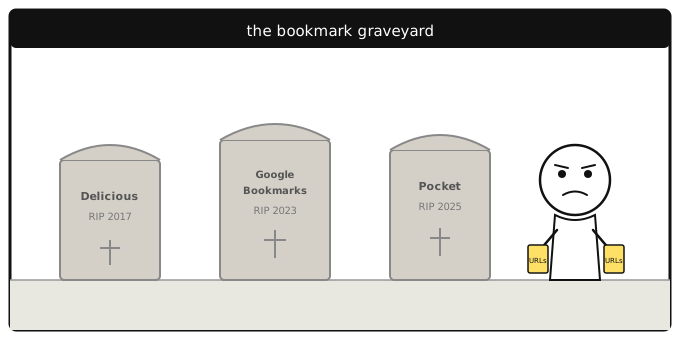
If you've ever lost a bookmark collection to a shutdown, you know the feeling. It's not catastrophic — it's not like losing family photos. But it's a slow, annoying erosion of something you built over years. All those links you carefully saved, tagged, and organized — gone because someone else's business model didn't work out.
The graveyard
Delicious (2003-2017) — The original social bookmarking service. Acquired by Yahoo in 2005, neglected, sold to AVOS in 2011, sold again to Pinboard in 2017, then shut down. Fourteen years of slow death by acquisition.
Google Bookmarks (2005-2023) — Google's standalone bookmark service, separate from Chrome bookmarks. Quietly discontinued in 2023 with minimal notice. If Google won't maintain a bookmark service, what does that tell you?
Pocket (2007-2025) — Started as Read It Later, rebranded to Pocket, acquired by Mozilla in 2017. Mozilla shut it down in 2025 as part of cost-cutting. Eight years of Mozilla ownership, then gone.
Diigo — Still technically alive, but development stalled years ago. The interface looks like 2012 because it is. Users report bugs that never get fixed.
Pinboard — A one-person operation that attracted a loyal following with its "social bookmarking for introverts" pitch. The sole developer moved on to other interests. The service still runs, but feature development stopped long ago.
Why they die
The pattern is remarkably consistent.
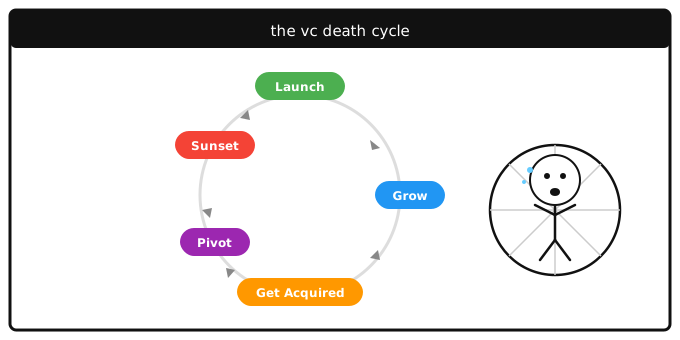
Free services can't sustain themselves. Delicious was free. Google Bookmarks was free. Pocket had a free tier that most users never upgraded from. When the money runs out or priorities shift, free users have no leverage. You're not a customer — you're a metric.
VC-funded companies need to 10x. Venture capital demands exponential growth. A bookmark manager is a utility — people use it steadily, not virally. When a VC-backed bookmark service can't hit hockey-stick growth targets, the founders pivot to something else or the company gets acqui-hired for the team, not the product.
Acquisitions kill products. Yahoo bought Delicious for the team and the user base, not because they cared about bookmarks. Mozilla bought Pocket to bundle it with Firefox, not to run a standalone service. When the acquirer's priorities change, the acquired product is the first thing cut.
Solo developers burn out. Running a web service is relentless. Servers need monitoring, spam needs blocking, support emails need answering, browsers keep changing APIs. A single developer can sustain this for years, but not forever.
What makes a bookmark manager survive?
Turn the failure patterns inside out and you get a blueprint for survival:
Paid from day one. When users pay, the business has customers instead of metrics. Revenue aligns incentives — the company survives by keeping users happy, not by chasing growth or selling data. This is boring. Boring is the point.
Small and sustainable. A bookmark manager doesn't need fifty engineers. It needs a small team that can maintain the service profitably without external funding. No VC means no pressure to pivot, no pressure to sell, no pressure to "grow or die."
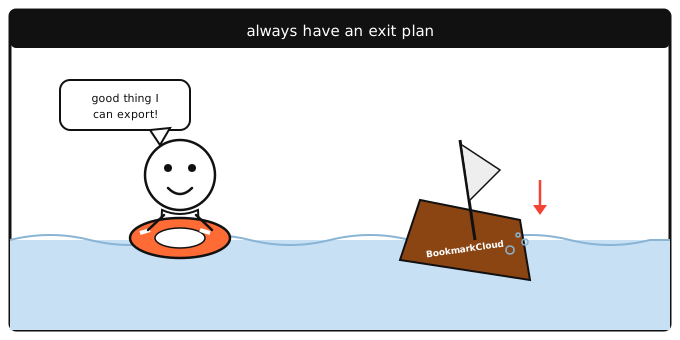
Standard export formats. Even the most trustworthy service should let you leave. Netscape HTML and XBEL are open bookmark formats that every browser and most bookmark tools can import. If a service doesn't support full export in a standard format, your bookmarks are hostages.
A track record. Anyone can launch a bookmark manager. The question is whether they'll still be running it in five years. Or ten. Or twenty.
LinkaGoGo's story
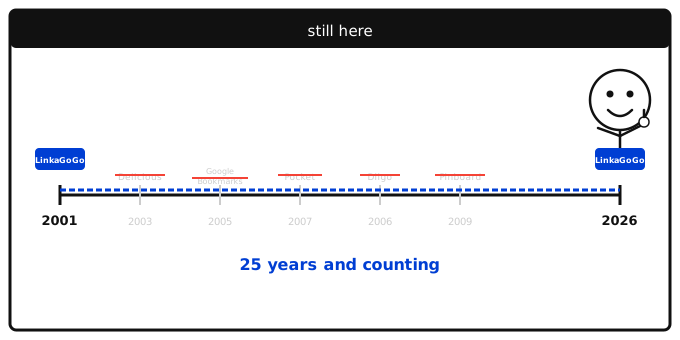
LinkaGoGo has been online since 2001. Twenty-five years.
It's not a startup. It's not VC-funded. It's not a side project that might get abandoned when something shinier comes along. It's a small, self-funded business that charges money for a service and uses that money to keep the service running. That's the entire business model.
Plans start at $4.99/year. Not $4.99/month — per year. The pricing is designed to be low enough that you never think about canceling, and high enough that the service can sustain itself without ads, data mining, or VC subsidies.
LinkaGoGo exports in both Netscape HTML and XBEL formats. If you ever want to leave, your bookmarks come with you. No lock-in, no data ransom, no "please contact support to request an export."
This isn't a pitch for why LinkaGoGo is the best bookmark manager in every dimension. It's a pitch for why it will still be here next year, and the year after that. In an industry where services keep dying, longevity is a feature.
How to evaluate any bookmark manager
Before trusting a service with your bookmark collection, ask these questions:
- Does it export? If not, walk away. Your data should be portable in a standard format (HTML or XBEL) at all times.
- Is it profitable? A free service with no clear revenue model will eventually shut down or start selling your data. Check if it charges money and whether those charges seem sustainable.
- Is it a side project? Solo-developer projects can be excellent, but they carry risk. If the developer loses interest, the service decays. Look for signs of active maintenance.
- Who owns it? If a VC firm owns it, the service exists to generate returns for investors, not to serve you. If a large company owns it, the service exists until the next cost-cutting round.
- How long has it been running? Longevity isn't a guarantee of future survival, but it's the best signal we have. A service that has been running for ten years has already survived the phases where most services die.
The boring conclusion
The best bookmark manager is the one that will still exist when you need it. Features matter, but they matter less than survival. A dead service with great features is worse than a live service with good ones.
Pick a bookmark manager that charges money, exports your data, and has been around long enough to prove it can last. Then stop worrying about it and go back to saving bookmarks.
Try LinkaGoGo free for 7 days — online since 2001, plans from $4.99/year, full export in HTML and XBEL.